
Three Lessons I Learned When My Car Broke Down
When my car suddenly stopped one kilometre away from my girlfriend's home, the inconvenience taught me three lessons about identity, gratitude and facing uncertainty.
Contents
I was one kilometre away from my girlfriend's home when my car suddenly stopped, and a world of confusion filled me. There are three distinct life lessons I learned from this incident, so I would just like to take a moment to share them with my dear readers.
So, there I was, driving home from the Bloemshow, which is kind of like a carnival, with my girlfriend. Everything was proceeding normally, but the moment I turned into the road where she stays, I suddenly saw my car's revs going up without me even pressing the accelerator.
I tried to switch gears, but that did nothing, so I immediately switched the car off. At that moment, I was confused about what had gone wrong. Was it the wheels? Was it the gearbox? What could it have been?
I turned the key one last time to check whether the car would move. The car started, but it would not go into gear, so I thought: a potential gearbox failure?
I called several towing companies, all with prices exceeding what I had expected, until I eventually found one reliable company and decided to go with them.
Now my car was stuck at home. I start work at 08:00, and I still had to get there on time. Work is nearly five kilometres away from home, so walking, as I thought at the time, seemed plausible.
The first morning, I walked to work. It took me about 40 to 45 minutes, and by the time I arrived, I had already decided: never again.
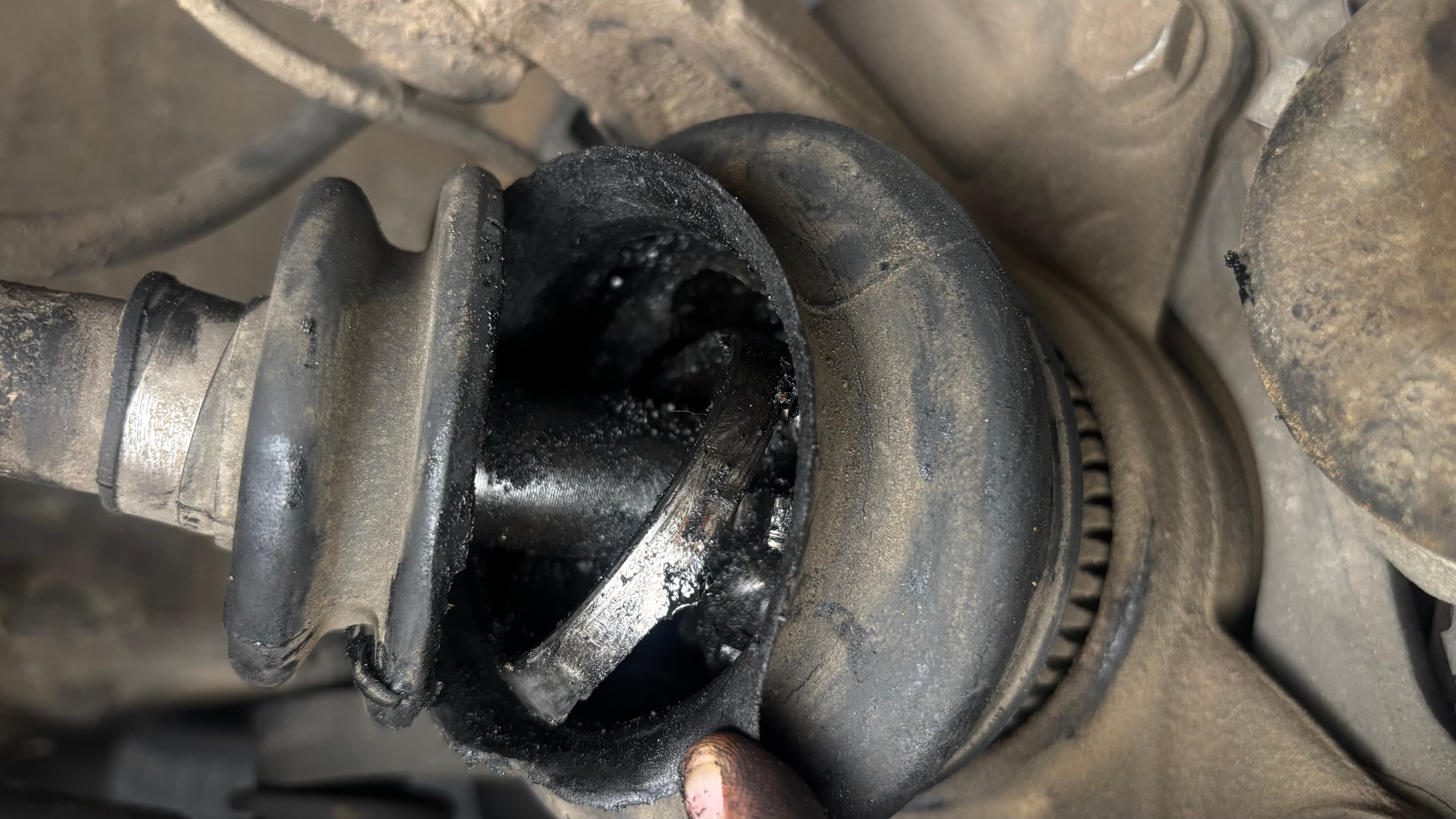
From there, I simply used Bolt. Eventually, the weekend came, which gave me the opportunity to properly investigate what had gone wrong. I jacked the right wheel up, but nothing seemed wrong. I then jacked the left wheel up and, lo and behold, I found the issue.
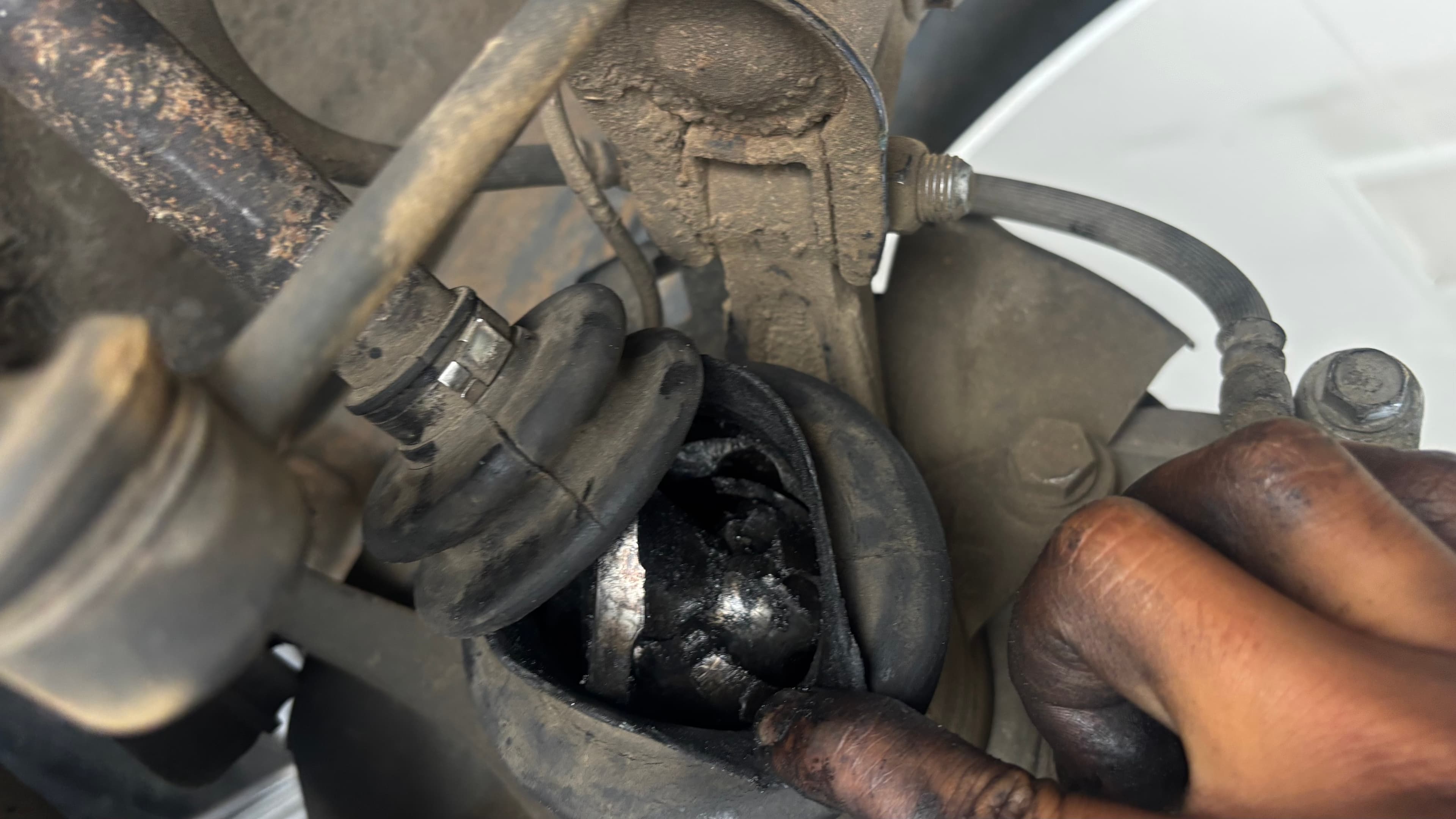
As you can see from the images, it was clearly a CV joint failure, and I now knew what to tell the mechanic.
I like getting my hands dirty and working on things myself, but when I do not have the tools or knowledge required to complete a job properly, I have no problem calling someone who does. The car was eventually fixed, and I could start driving again.
However, this incident taught me several important lessons, which I will explore throughout this blog post.
The first lesson was that everything we own is temporary. Everything we have is either given to us or worked for, but it can eventually be taken away.
The second lesson was that we do not truly value what we have until it is taken away. We become so accustomed to the things in our lives that we begin to believe they will remain there forever.
The final lesson was that when life throws you a curveball, you should not duck and dive. You should swing with full force. You may miss, but at least you did not cower in the face of the unknown.
Everything Is Temporary
Before we delve into this, I first want us to talk about identity.
The way I view identity is simply what you identify as, or what you identify with. By this, I mean that we have multiple things to which we attach our identity.
From a broad perspective, I think identity involves how we view ourselves and how we think others view us. The important word here is "think", because unless someone explicitly tells you what they think of you, you may simply be guessing.
Nonetheless, our identity is often connected to the things to which we attach value. These may be physical things such as cars, phones, clothing and money, or intangible things such as our personalities, values, beliefs and character.
Imagine a world where all I placed value in were the material things of life. If I eventually lost those things, and anything that is given or earned can be taken away, what would I attach my identity to then?
I would probably become a wandering person, potentially driven into depression, because the way I viewed myself and the way I believed others viewed me would come crashing down. My identity would have been attached to something as temporary as a car.
I do not know about you, but that is not a world I would like to live in.
This does not mean that we should not enjoy the things we have. There is nothing wrong with enjoying your car, your home, your phone, your clothing or anything else you have worked hard to obtain. The problem begins when those things stop being possessions and start becoming the foundation of your identity.
A car should be something I own. It should not determine who I am.
When my car broke down, my life suddenly became more difficult, but I was still the same person. I still had work to do. I still had responsibilities. I still had people who cared about me, and I still had the ability to make a plan.
The car's failure inconvenienced me, but it did not decrease my value as a person.
I faced the issue head-on and tried my best to adapt instead of allowing the situation to ruin everything I had to do daily. By accepting that everything is temporary, we begin to release our attachment to things that cannot always be controlled by us.
This does not mean that we should constantly live in fear of losing everything. Rather, it means understanding that the things around us can change, break or disappear, while ensuring that our entire sense of self does not disappear with them.
This was the first lesson: take everything in life as temporary, even when it may remain with you for many years. Doing so may protect you from some of the disappointment that arises when life changes unexpectedly.
After all, what is life but a string of seemingly random events that gradually form the reality we perceive?
Value What Is Yours
I had driven my car so often that driving no longer felt like a privilege. It simply felt normal.
I would get into the car, start it, drive to work and continue with my day without thinking about how much easier the car made my life. I did not have to plan my morning around transport. I did not have to wait for someone to collect me. I did not have to calculate how much every trip would cost.
I could simply get into my car and go.
However, the moment that ability was taken away, I began to understand its value.
Walking to work for the first time made me realise how convenient my car had made my life. A journey that usually took only a few minutes suddenly became a 40 to 45-minute walk. Using Bolt was more convenient than walking, but every trip cost money, and I still had to wait for the driver to arrive.
For only a few days, my independence had been limited, and that was enough to change how I viewed my car.
This principle does not only apply to material things.
We often become accustomed to the people in our lives as well. We become used to our parents being available, our partners supporting us, our friends answering our messages and our colleagues helping us when we need them.
Because their presence becomes normal, we sometimes forget that their presence is valuable.
The same can be said about our health. We wake up, walk, breathe, eat and continue with our lives without thinking about how many processes must work correctly for us to perform even the simplest task.
It is only when we become sick, injured or exhausted that we suddenly remember how valuable it is to feel normal.
Perhaps that is one of the strange things about being human: we adapt quickly to what we have. Something that once brought us great joy eventually becomes part of our normal routine. We stop seeing it as a blessing and begin seeing it as something we are simply entitled to have.
The problem is not that we become comfortable. The problem is that comfort can slowly turn into carelessness.
When my car returned from the mechanic, the first drive felt completely different. The car was not new. It had not suddenly transformed into an expensive vehicle. It was the same car I had been driving before, but I appreciated it more because I had experienced what life was like without it.
Sometimes, nothing needs to improve for us to become more grateful. Sometimes, we only need to look at what we already have with fresh eyes.
Value what is yours while it is still yours.
Appreciate the person who checks on you. Appreciate the job that allows you to earn an income. Appreciate the body that carries you from one place to another. Appreciate the small conveniences that make your days easier.
You do not have to lose something before recognising its value.
Face Curveballs Head-On
When my car stopped moving, I could not immediately see what had gone wrong.
I did not know whether the problem was the gearbox, the wheels, the clutch or something completely different. All I knew was that I was sitting inside a car that was no longer taking me anywhere.
That uncertainty was probably the most uncomfortable part of the situation.
It is often easier to face a problem when you understand exactly what the problem is. You can begin finding solutions, calculate the cost and decide what must happen next.
However, when you do not know what went wrong, your mind begins creating possibilities. Some of those possibilities may be realistic, while others are simply driven by fear.
A gearbox failure, for example, could have been extremely expensive. Because I did not know what the issue was, I could easily have allowed my thoughts to convince me that the worst possible outcome had already occurred.
But worrying would not have moved the car.
I still needed to call a towing company. I still needed to find a way to get to work. I still needed to investigate the problem, and I still needed to arrange for the car to be repaired.
So that is what I did.
I called different towing companies until I found one I could use. I walked to work when I had no other plan. When I realised that walking was not sustainable, I used Bolt. When the weekend came, I jacked the car up and inspected the wheels until I found the damaged CV joint.
At every stage, I simply dealt with the problem in front of me.
I did not solve everything at once, but I continued moving.
That is what facing a curveball means to me. It does not mean that you always have the perfect response. It does not mean that you are never confused, frustrated or afraid.
It means that even while feeling those emotions, you still choose to act.
Life will not always give us enough time to prepare. Sometimes things will break. Plans will fail. People will disappoint us. Opportunities will disappear, and circumstances will change without asking whether we are ready.
We cannot always control what is thrown at us, but we can control whether we swing.
You may make the wrong decision. You may waste money. You may ask the wrong person for help. You may try something that does not work.
But every attempt gives you more information than standing still.
My first plan was to walk to work. That plan technically worked, but after one morning, I realised it was not the best long-term solution. So I changed the plan and used Bolt.
I initially suspected that the gearbox might have failed. After inspecting the car, I discovered that the actual problem was the CV joint.
Being wrong did not mean that I had failed. It simply meant that I had more information and could make a better decision.
Sometimes we become so afraid of making the wrong move that we make no move at all. We wait until we understand everything, until the conditions are perfect or until someone guarantees that our choice will succeed.
Unfortunately, life rarely gives us that guarantee.
When the curveball comes, swing.
You may miss, but at least you will learn where the ball is going.
Final Thoughts
A broken CV joint may not sound like a life-changing event, and perhaps it was not. My car was repaired, I returned to my normal routine, and life continued.
However, ordinary situations can still reveal important truths.
This incident reminded me that everything I own is temporary and that my identity should never be built entirely upon material possessions. It reminded me to value the things and people in my life before I am forced to experience life without them.
Most importantly, it reminded me that confusion is not an excuse to surrender.
When something goes wrong, I may not immediately understand why it happened or how I am going to fix it. I may feel frustrated, inconvenienced or afraid of what it could cost me.
But I can still take the next step.
Sometimes that next step is calling a towing company. Sometimes it is walking five kilometres to work. Sometimes it is admitting that you do not have the right tools and asking someone else for help.
The step does not need to be impressive. It simply needs to move you forward.
So, my dear readers, enjoy what you have, but do not allow it to define you. Appreciate the people and opportunities in your life while they are still present. And when life suddenly leaves you stranded one kilometre away from where you expected to be, do not cower in the face of the unknown.
Take a breath, look at what is in front of you and swing.